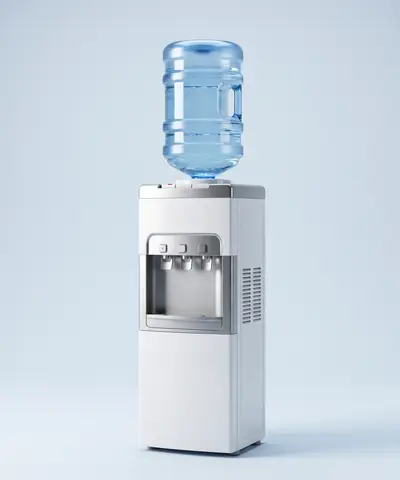
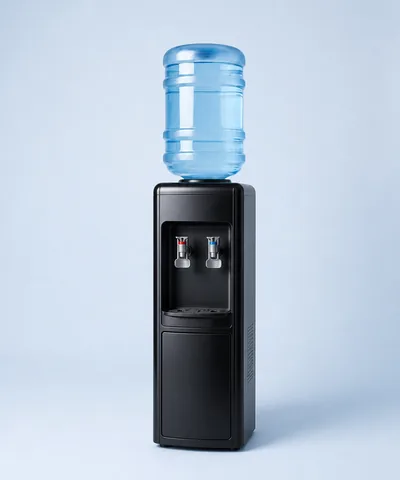
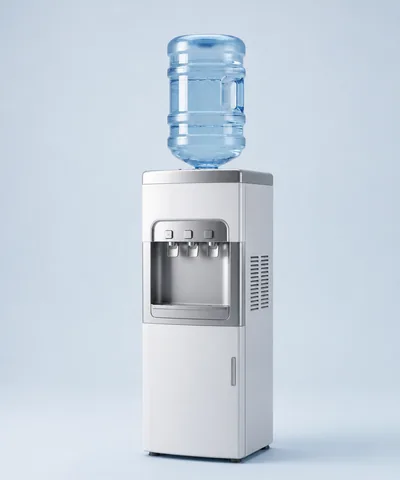






Water cooler with cooling and heating: two units in one body
Two independent systems live inside the body. Heating is a tank of about a litre with a tubular electric heater and a thermostat: the water in it is kept hot all the time, not heated when you press the tap. Cooling is a separate circuit with its own tank, and it is connected to the hot one by nothing except the shared body and the shared socket.
This separation is not a designer's whim. The hot tank holds about ninety degrees, the cold one five to twelve, and a shared circuit would mean the appliance heating what it had just cooled. So water from the bottle reaches each tank by its own route, and at the outlet a two-tap model has no room-temperature water at all: there is hot and there is cold.
Hence the first practical consequence: each system has its own switch on the back panel, and either can be turned off. Half the complaints that the appliance eats electricity go away once the hot tank is switched off at night and at weekends, and in summer sometimes not switched on at all.
The second consequence concerns expectations. The cold tap does not give ice, and the hot tap does not give boiling water in the strict sense. The cold comes out about like water from a bottle that has been in the fridge for half an hour. The hot is just below boiling point: tea and packet soup will brew, but you cannot use it to boil water for sterilising.
Heating and boiling are different things
Price lists sometimes call the hot tap a boiling-water tap, and almost every disappointment grows out of that inaccuracy. The tank has a tubular heater with a thermostat, and the thermostat keeps the water in a range of roughly eighty-five to ninety-five degrees — at the threshold of boiling, but not past it. Boiling is a hundred degrees with steam coming off, and a closed tank under constant heating has no need for steam: there is simply nowhere for it to go.
A difference of five to fifteen degrees seems minor, but in practice it splits tasks into two piles. Black tea, coffee in a cup, cocoa, packet soup, instant porridge, a hot water bottle — all of these brew perfectly well at ninety. For green tea and oolong ninety is even too much, they need about eighty, and here a cooler is handier than a kettle: it does not overheat and does not make you wait for boiled water to cool.
The second pile is what the appliance does not do. You cannot sterilise dishes, teats and baby bottles with its water. Baby formula is made up according to the manufacturer's instructions, and if they say to boil and cool, hot water from the tap does not replace that line: it is hot, but not boiled. Gelatine and dishes that need actual boiling water will also stay half-done.
A short list for those choosing an appliance for a particular task:
- Black tea, coffee in a cup, cocoa — yes, the temperature is right for them.
- Green tea and oolong — yes, and they come out more even than from a kettle that has just boiled.
- Instant noodles and porridge, packet soup — yes, they just need a minute or two longer to steep.
- Baby formula — only if the instructions for the formula itself do not require boiling.
- Sterilising baby bottles, teats and jars — no, that needs boiling water and time.
This kind of heating has a pleasant side too. Water that has not been brought to the boil loses less dissolved air and does not take on the taste familiar from a kettle with limescale. Limescale in the tank itself also builds up more slowly than in a kettle of the same capacity — precisely because salts come out of solution most actively during boiling, and here no boiling takes place.
Checking the temperature is easier than arguing about it. The appliance usually has no thermometer, and the only honest way is to pour a glass a quarter of an hour after switching on and measure it with a kitchen thermometer. If the water is noticeably below eighty with a full bottle and the switch on, the cause is either the thermostat or that the tank has not had time to recover after heavy use.
Compressor or electronic cooling
Electronic cooling works on a Peltier element: a semiconductor plate with one cold side and one hot side, and a fan that blows the heat outwards. There is no mechanism inside, almost nothing to break, and the only sound is a fan. The trade-off is that such an element lowers the temperature relative to the room, not down to a set point. In a hot kitchen the water from the cold tap will be noticeably warmer than in the same flat in winter.
Compressor cooling is a fridge in the cooler's cabinet: compressor, refrigerant, evaporator. It holds the temperature regardless of how warm the room is, and quickly restores the cold after several glasses in a row have been drawn from the tank. The price is weight, cost and sound: the compressor switches on in cycles, and you can hear it just as you hear a kitchen fridge at night.
There is also an in-between case people ask about most often: an appliance with electronic cooling in a cool room. It behaves like a compressor model right up to the first heatwave — in winter, in an office with a north-facing window, you will not notice any difference between the two systems, but in July it becomes the main one. So the choice is made not by the city's average temperature but by what the room is like in the worst week of the year.
| What we compare | Electronic, Peltier element | Compressor |
|---|---|---|
| How it cools | relative to room temperature | to a set point, regardless of the heat |
| Recovery after use | slow: you cannot pour a lot of cold water in a row | fast, designed for steady use |
| Noise | a fan, audible close up | switches on in cycles, sounds like a fridge |
| Weight and price | lighter and cheaper | heavier and more expensive |
| Who it suits | home, private office, office of up to ten people | office with heavy use, hot room |
Household appliances have no third cooling method, and that is worth keeping in mind when reading price lists: anything called thermoelectric, semiconductor or simply quiet is the same Peltier element under another name, and anything that cools deeply and quickly works like a fridge. If the type is not named at all, the weight gives it away: a compressor model is five to seven kilograms heavier than a comparable electronic one.
Litres per hour: how much it can heat and cool
The specifications list two performance figures, and they should be read together with the tank sizes. Heating usually gives five to seven litres an hour at a power of about five hundred to six hundred and fifty watts. Cooling on a Peltier element gives less than a litre an hour, compressor cooling two to three litres. This is not a marketing difference but physics: the plate removes heat more slowly than a refrigeration circuit.
The tanks themselves are small. The hot one holds about a litre, the cold one from a litre in compact models to three in floor-standing compressor ones. So in one go the appliance gives exactly what is in the tank, and after that it works at the speed of its output. Four mugs of tea in a row is the usual limit of the hot tank: the fifth will be warm, and you will have to wait a few minutes for it.
| Figure | Typical value | What it means in the kitchen |
|---|---|---|
| Heating power | 500–650 W | the tank reaches temperature 10–15 minutes after switching on |
| Heating output | 5–7 litres per hour | about four mugs in a row, then a pause |
| Peltier element cooling | less than a litre per hour | three or four glasses in a row, recovery in about half an hour |
| Compressor cooling | 2–3 litres per hour | keeps up with steady use, recovers many times faster |
| Cold tank capacity | 1–3 litres | this is the reserve the appliance gives in one go |
Hence a practical conclusion for offices. An appliance for four people and one for twenty differ not in body size but in whether the tanks recover between visits. Twenty people at lunchtime drain the cold tank in a few minutes whatever its capacity, and what saves the day is not volume but speed of recovery, that is, a compressor. Where people come for water at different times all day, electronic cooling is enough.
One more figure worth knowing in advance is the time to first reach temperature. Hot water comes after ten to fifteen minutes, cold with electronic cooling after about an hour, noticeably sooner with a compressor. So an appliance delivered during the day is fully working by evening, and there is no point pouring from it straight after switching on: you will get room-temperature water from both taps and decide it is faulty.
And about how these figures are obtained. The output in the specifications is a steady state at a room temperature of about twenty-five degrees and with a full tank. In a hot kitchen and with frequent use it is lower, sometimes noticeably. So specification litres per hour are good for comparing models with each other and poor as a promise.
Hot and cold water cooler price: what it is made up of
The price difference between models is almost entirely a difference in cooling method and body. The desktop model costs from 4 790 KGS, the floor-standing one with electronic cooling from 7 290 KGS, the floor-standing compressor one from 10 490 KGS. Beyond that, the price rises as a third feature is added to the two taps: a bottom-loading pump (from 12 490 KGS, more than a floor-standing model with the bottle on top) or a fridge compartment in the cabinet (from 11 990 KGS, more than an ordinary compressor unit). We have separate pages on both add-ons.
You do not have to own the appliance. Rental runs from 400 KGS a month for a desktop model up to 700 KGS for a compressor one, and with an order of 15 bottles a month or more, rental is free — the thresholds and what the service includes are set out on the rental page. Delivery, installation and sanitising cost nothing, whether you buy or rent.
Besides the cooling method, the price includes one more thing that the specifications list in small print — the tank material. Stainless steel costs more than plastic and lasts longer: it does not pick up odours and copes better with sanitising. On an appliance that stands in an office and is used every day, the difference shows by the second year; on one that gives a couple of glasses a day, it may never show at all.
How much electricity such a cooler uses
The main consumer is heating. The heater switches on not when you press the tap but when the water in the tank has cooled below the threshold, and that happens many times a day. Cooling uses less, but a compressor switches on more often in hot weather, and a Peltier element runs almost continuously.
Three habits noticeably change the bill: switch off the hot tank when it is not in use; do not put the appliance right against a wall, next to a cooker or radiator, or in direct sun — a warm body has a harder time giving off heat; do not keep the cooler switched on with an empty bottle. The last is also dangerous for the heater: running dry kills it faster than anything else.
The orders of magnitude are these. Heating is several hundred watts, switching on in short cycles all day. Cooling ranges from a few dozen watts for a Peltier element, which runs almost continuously, to a hundred or more for a compressor, which switches on more often in hot weather. Adding them up into a monthly figure any more precisely than “roughly like a small fridge” is not possible: everything depends on how often the taps are used and how warm the room is.
What fails in each of the two units
The two systems break down separately, and that is good news: the failure of one does not put the whole appliance out of action. One whose tank has stopped heating keeps cooling, and vice versa. The less good news is that half of all failures come not from age but from three habits: running dry, a recess with no airflow and skipped sanitising.
The hot unit has three weak points. The heater — running with an empty tank kills it, and the protection trips once, after which the tap goes silent for good. The thermostat — when it fails, the water either stays barely warm or the tank starts gurgling, which it should not do normally. And limescale: it settles on the heater even without boiling and over time makes it deaf to the water around it.
The cold unit has two weak points, and they differ between systems. For electronic cooling it is the fan and a grille clogged with dust: the cold fades gradually and the noise grows. For a compressor it is the start relay, which responds with clicks but does not start, and a refrigerant leak, where the appliance hums and runs but does not cool. Neither can be fixed at home.
| What you noticed | Most likely | What to do |
|---|---|---|
| The hot water has become warm | thermostat or limescale on the heater | switch off, let it cool, call a technician |
| No hot water at all after an empty bottle | the heater protection has tripped | service centre: it does not reset by itself |
| The cold water warms up towards evening and in hot weather | the Peltier element lacks heat dissipation | move it away from the wall, clean the grille |
| It hums but does not cool | refrigerant leak | service centre, the circuit is not recharged on site |
| It clicks and does not start | compressor start relay | service centre, the part is replaced |
| Aftertaste and smell from both taps | the tanks, not the water | sanitising |
The most common of these cases is lost hot water, and it is worked through in order, from free to paid:
- Check the hot circuit switch: people turn it off at night and forget to turn it back on more often than you would think.
- Make sure there is water in the bottle: an empty bottle is the first cause and the only preventable one.
- Give the appliance twenty minutes after heavy use — the tank may simply not have caught up.
- Pour a glass and measure the temperature, so you can give the technician a figure rather than a feeling.
- If the water is below eighty with the switch working and a full bottle, it is a job for the service centre.
And about what not to do with any of these symptoms. Taking the body apart to have a look — inside there is mains voltage and a sealed circuit that cannot be put back together once opened. Pouring vinegar or citric acid into the tank at random — that helps a kettle with limescale, but here the acid meets silicone seals and plastic tubes. And putting off lost cooling: a leak with which the compressor keeps running ends with a seized motor.
Buying a floor-standing hot and cold water cooler or renting one
What is worth counting is not the price of the appliance but the time frame. If you have been drinking bottled water for years and are not moving anywhere, buying works out cheaper over time. If you rent your home, are opening an office for six months or do not yet know whether a cooler will catch on, rental is the fairer option: the appliance is taken back without any fuss, and the servicing is on us the whole time.
| What it is called in the price list | Cooling | Where it stands |
|---|---|---|
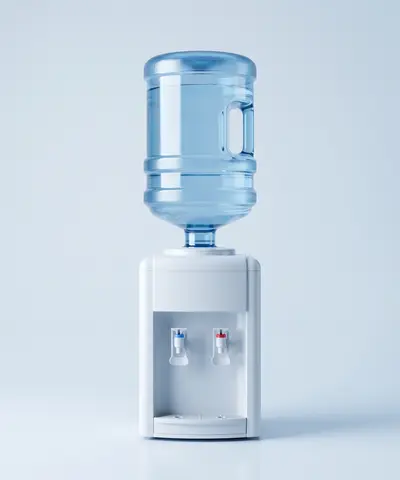
| Desktop water cooler with cooling and heating | electronic | kitchen, private office, reception — wherever there is a free cabinet |
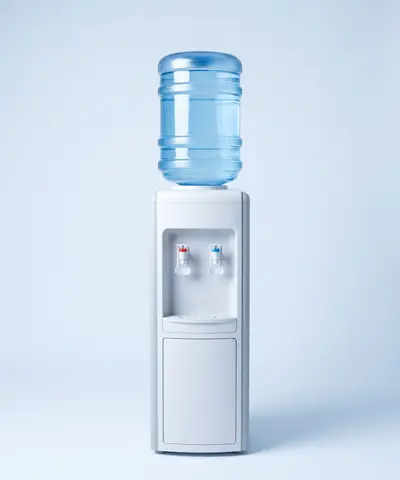
| Floor-standing with electronic cooling | electronic | flat, small office, waiting area |
| Floor-standing compressor | compressor | office with steady use, workshop, hot room |
The hot tap and children
On a working model the hot tap is never just a push tap: it has a lock — a key you have to hold down or slide before turning the lever. A three-year-old cannot repeat that sequence, but will press a simple button first time. If there are small children at home and the tap has no lock, there is only one answer: the heating is switched off with the switch and stays off.
A second conversation in the same place is about burns caused not by the tap but by habit. Hot water is poured into a thin plastic cup, which loses its shape right in your hand; a mug is filled to the brim and carried across the room. The same goes for a kettle, but a cooler's tap is at a child's face level, so both rules are said out loud: fill no more than three-quarters, and only into cups held by the handle.
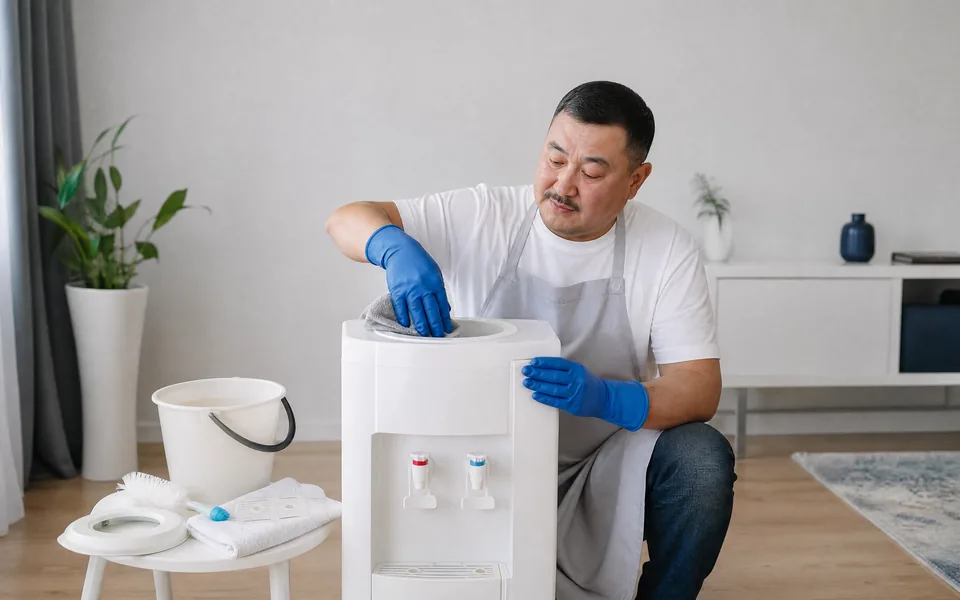
- Sanitising the tank and taps — once every six months with normal use; with us it is included in the service.
- The neck of a new bottle is wiped before fitting: anything left on the cap goes into the tank.
- On most models the heating is switched off before changing the bottle, so the tank does not run idle.
- The drip tray is wiped dry: standing water in it gives off a smell, and that is not just a cosmetic flaw.
- Leave a hand's width of free space between the body and the wall.
What you need to get the cooler working today
You need a socket, a level floor or a sturdy cabinet, and the first bottle. The courier does everything else: brings it, sets it up, switches it on, shows you where the switches are and takes the packaging away. Water for it costs from 230 KGS per bottle, and delivery in the city is free from 2 bottles per order. Which model to choose — tell us on WhatsApp how many of you there are and how much water you get through in a week: that is enough to give a more precise answer than any table.